
Does Size Really Matter?
Why bigger hotel rooms are costing Indian Developers more than they think
India's hotel developers have a costly habit: build bigger rooms and assume the market will reward them. It won't.
Walk into almost any hotel development meeting and you'll find the same argument playing out: owners pushing for larger rooms, brands advocating for their minimum specifications, and everyone convinced that more space means more revenue. Yet, the data disagrees — conclusively.
Hotelivate's analysis of branded hotel RevPAR and Room Size across India for 2024/25 cuts through the assumption. Whether you look at urban or leisure hotels, north or south, Tier 1 or Tier 3, Indian-origin brands or international — the findings converge on one conclusion: room size has a limited correlation with RevPAR. At an average development cost of ₹11,300 per sq. ft., the industry's appetite for oversized guestrooms is not ambition. It's capital destruction.


THE DATA: WHAT INDIA'S HOTELS ACTUALLY TELL US
Hotelivate analysed the correlation between base room size and RevPAR across branded hotels in India for 2024/25 — examining the data by location type, administrative zone, brand origin, hotel size, city tier, and positioning.
The findings converge, consistently, on the same conclusion.
1. Nationwide RevPAR vs Room Size: The Mirage of a Trend

2. Urban India: A 30% Size Gap, Near-Zero RevPAR Difference
Among urban hotels — which represent 55% of our sample — properties with base room sizes between 35 m² and 45 m² deliver broadly similar RevPAR. Let that sink in – a 30% difference in room size produces no meaningful difference in RevPAR. For urban owners who have added 10 sq. m. to every guestroom — at a substantial capital cost — this should be a wake-up call.


3. Leisure Hotels: Bigger Rooms Backfire
The leisure segment — 45% of our sample — produces perhaps the most striking finding in this entire study. Hotels with base room sizes between 45 m² and 50 m² outperform those with rooms exceeding 50 m². Developing rooms that are at least 11% larger does not just fail to deliver better performance — it actively correlates with a lower RevPAR. There is no polite way to put this: building oversized rooms at leisure destinations is a value-destroying decision.


4. Regional Breakdown: Consistent Story, Different Accents
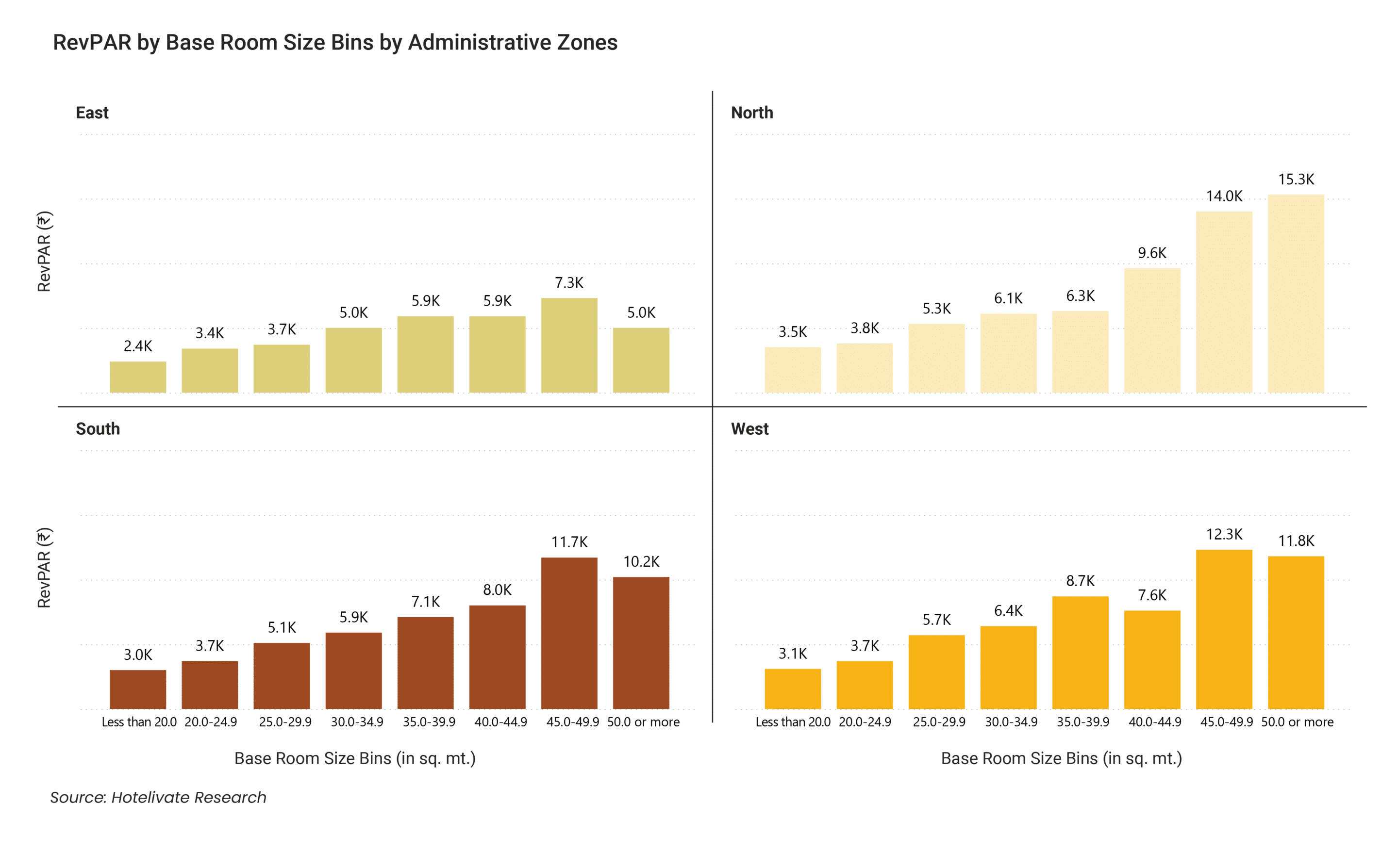
Analysing the data by administrative zone provides a few regionally specific nuances worth noting:
-
-
- East, South & West (~60% of sample): The 45–50 m² bracket outperforms the 50 m²+ category. Building bigger rooms is not generating better returns.
- East & West (~37% of sample): Rooms in the 35–40 m² range match or beat the 40–45 m² range. A 30% size difference produces no performance advantage — and sometimes a disadvantage.
- North (~40% of sample): The 30–40 m² range shows near-identical RevPAR performance. A 33% size increase from one end of the spectrum to the other delivers no material gain whatsoever.
-
5. Hotel Size Lens: More Space, Less Return
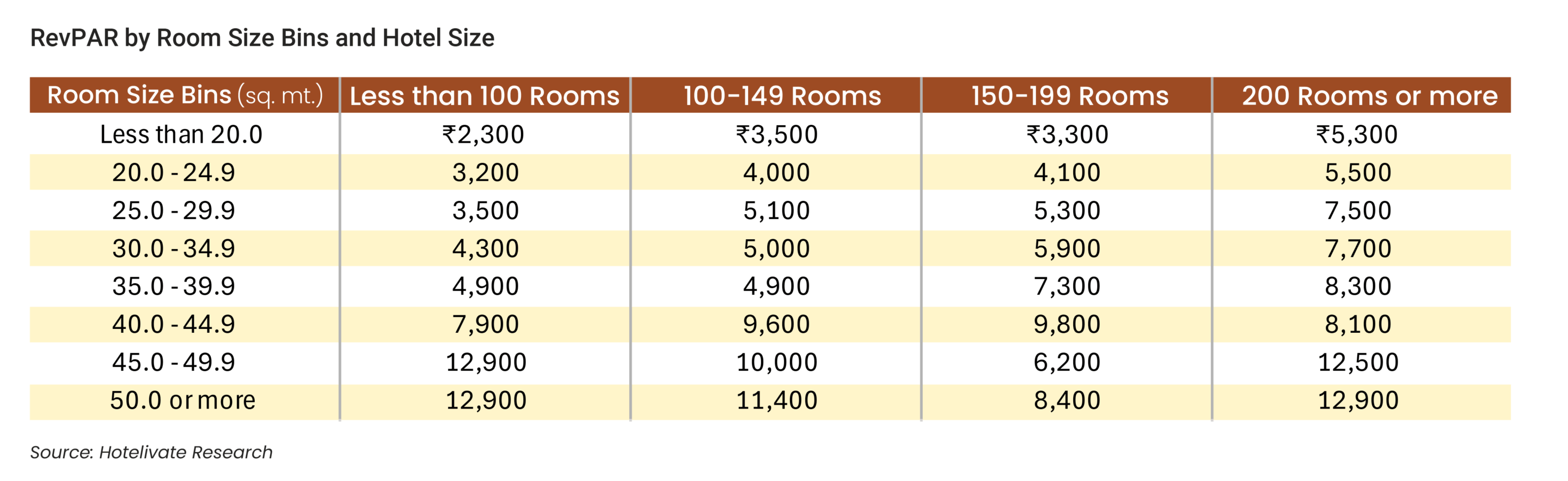
Among hotels with an inventory between 100 – 149 keys (~17% of sample), there is no discernible difference in RevPAR across rooms ranging from 25 m² to 40 m² — a 60% difference in size. In fact, RevPAR declines at the upper end. For hotels with an inventory of 150 keys or more (~18% of sample), the 25–35 m² range delivers stable performance with no gain from the 40% room size increase.

6. Tier 2 & 3 Markets: Over-Building Risk is Greatest Here
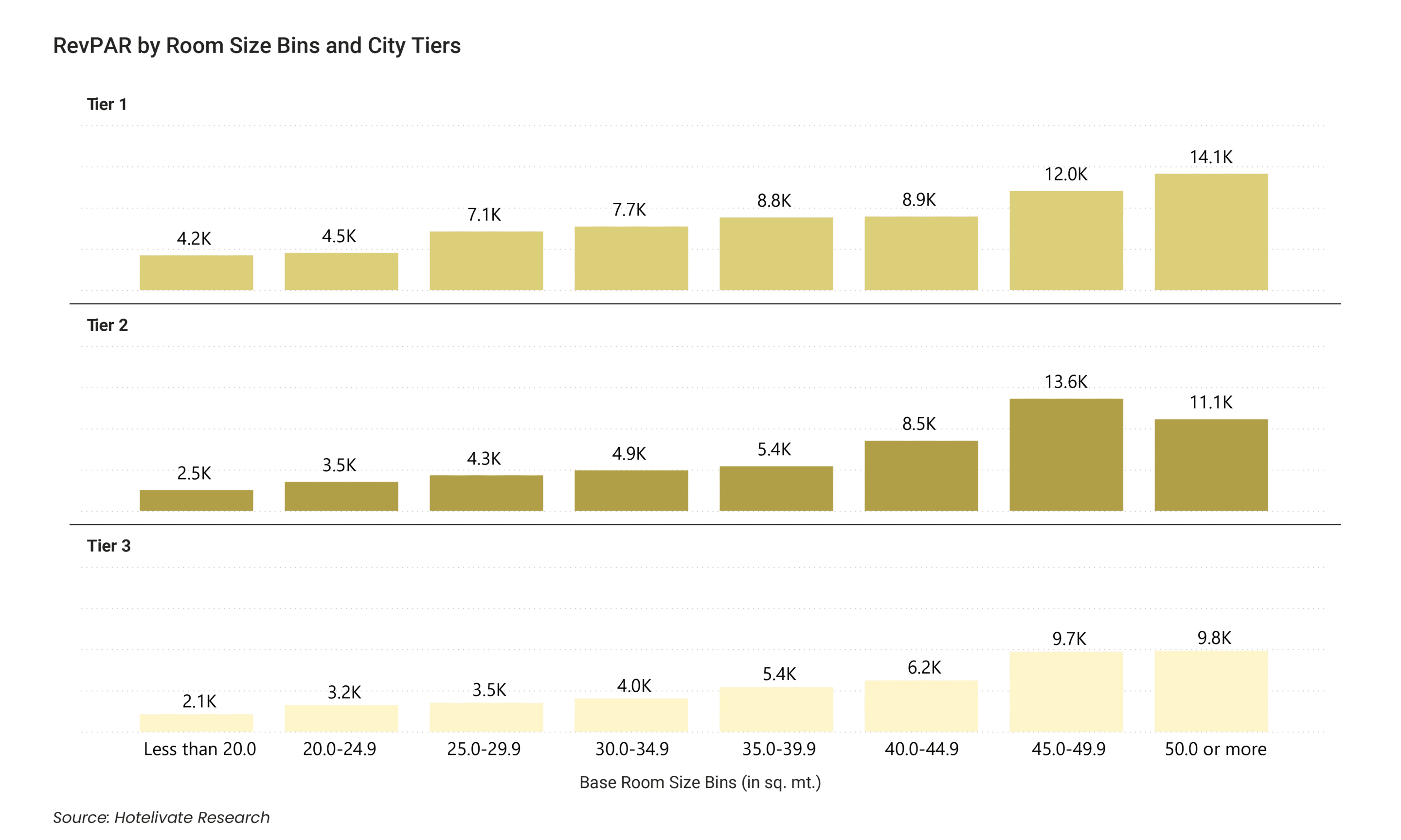
In Tier 2 and Tier 3 markets, hotels with 45–50 m² base rooms perform at par with — or better than — those with rooms above 50 m². Over-specification in Tier 2/3 cities is not just unnecessary; it can be economically catastrophic for project viability.

THE SWEET SPOTS: SEGMENT-BY-SEGMENT GUIDANCE
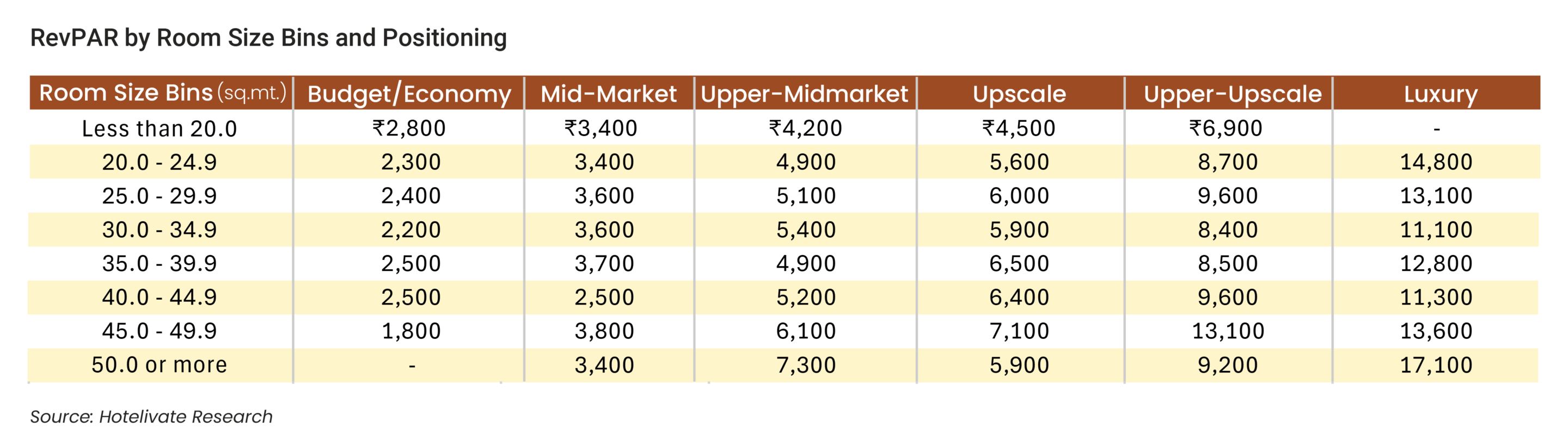
The most actionable output of this analysis is the identification of room size ‘sweet spots’ by positioning — the point at which RevPAR is optimised relative to development cost. Beyond these thresholds, additional floor area adds cost without adding performance.

THE HARD TRUTH: WHAT'S REALLY DRIVING PERFORMANCE
Room size is a distraction from the factors that genuinely determine a hotel’s financial success. Our analysis points clearly to what actually moves the needle:
-
-
- Location, location, location. The primary determinant of performance remains unchanged. A well-located hotel will always outperform a poorly located one.
- Brand strength and distribution reach. A powerful brand driving occupancy through its network is worth far more than 10 extra square metres of guestroom.
- Product-market fit. A hotel designed for the specific expectations of its target market and the business segments — not a generic developer’s instinct or a brand’s gold-plated standard — consistently outperforms.
- Legacy and character. Hotels are, by nature, long-term investments. As holding periods extend, it is legacy, character, and history — not room dimensions — that tend to distinguish the consistently strongest performers.
-

CONCLUSION: BUILD RIGHT, NOT BIG
India’s hotel development pipeline has never been more active, with over 120,000 rooms planned (over 50% of the existing supply base). The growth and the opportunity are real. Yet too much of this opportunity risks being squandered on oversized developments that will show up as underperformance for years — locked into the fabric of the building and impossible to reverse.
The evidence is clear and consistent: beyond the sweet spot, additional room size adds cost, not value. The developers who will build the best-performing assets of the next decade will not be the ones with the grandest briefs. They will be the ones with the sharpest discipline — those who let market data, not instinct, determine what gets built.
Right-size the room. Right-size the return.

For more information, please contact Mihir at mihir@hotelivate.com and Megha at megha@hotelivate.com
