
Leadership in a World on Fire
When the theme for the 21st edition of HICSA was conceived, few could have anticipated how swiftly it would move from a thought on paper to reality. Today, the convergence of climate volatility, geopolitical instability, and rapid AI advancement has created an environment of unprecedented complexity, one that demands bold, adaptive leadership.
In the lead-up to the conference, a leadership data collection initiative was undertaken, the full implications of which only became clear as the findings took shape. This article presents the key insights on hospitality leadership that were revealed and shared at HICSA, offering a timely lens through which industry leaders can reflect, respond, and reimagine the road ahead.
What Defines Hospitality Leadership Today?
There is a certain predictability to leadership in the hospitality industry—not the kind born out of inertia, but one shaped by repetition. Over decades, patterns have compounded quietly, creating a leadership model that is both consistent and enduring. Our analysis of close to 100 senior hospitality leaders across the globe reflects this clearly. Leadership is built on experience, anchored in operational exposure, and reinforced by tradition—it is not an early achievement, but a culmination and has served the industry well. But like many systems that rely heavily on precedent, it now stands at an inflection point.
To better understand how this model is evolving, our analysis also considers generational differences within the leadership cohort—comparing leaders aged 55 and above with those below 55. This provides additional context on how leadership pathways and experiences are beginning to shift over time.
The data reflects a cohort shaped by deep experience, cross-sector exposure, and varying degrees of geographic responsibility.
rrelation largely dissolves. Aggregated averages are a developer’s comfort blanket — pull them away and the picture becomes far less reassuring as the correlation tends to minimise.
Key characteristics of the sample set include:
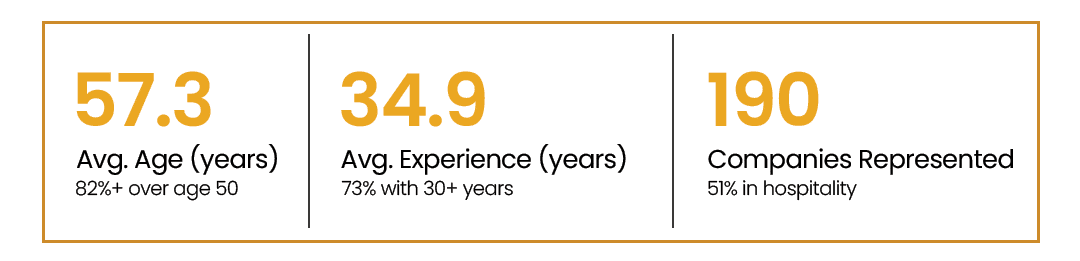
1. Average age: 57.3 years, with over 82% of leaders above the age of 50
2. Average experience: 34.9 years, with 73% of leaders having over 30 years of experience
3. Company exposure: 190 companies, with 51% in hospitality, 10% in consulting, 10% in real estate, 12% in financial services, and 17% across other sectors
4. Geographic scope: 49% regional roles, 18% in transcontinental roles and 33% global roles.
5. Leadership Roles Represented in the Sample Set: CEO (33%), Managing Director (19%), President (17%), Vice President (13%), and Chairman (9%)
Sample Set Overview
Leadership Data: Sample Set

Job Experience as a Currency
Hospitality leadership has long been earned over time. Leaders in this cohort have navigated multiple disruptions, and their decisions are shaped by decades of pattern recognition. The result is a level of stability, resilience, and operational discipline that few industries can match. This depth of experience has been central to how leadership in the industry is built.
However, this same depth also shapes how leadership evolves. The distribution of experience further underscores this: 43% of leaders have 30–39 years of experience, while 30% have more than 40 years. In contrast, only 2% of leaders have less than 20 years of experience, reinforcing how leadership remains a late-career outcome. While this reduces execution risk, it can also delay the introduction of new perspectives—reflected in the fact that only 17% of leaders are under the age of 50.
At the same time, emerging cohort differences point to a gradual evolution. Younger leaders are entering leadership roles earlier, often with more varied functional experience, indicating that while experience remains foundational, the pathway to leadership is beginning to broaden. The next phase of leadership will likely require greater adaptability, a faster pace of renewal, and broader exposure to new capabilities.
The Dominance of the Operator-Leader
If there is one defining trait of hospitality leadership, it is operational depth. An overwhelming 93.2% of leaders have exposure to operations, making it the near-universal foundation of leadership development. Hospitality is, at its core, an execution business—where service delivery, consistency, and attention to detail define success.
Yet this operational strength is not evenly balanced with other forms of experience. While 71.6% of leaders have experience in development, only 21.6% have exposure to finance-led roles and 18.2% to consulting environments. Among those with exposure to finance and consulting, 25% have worked in top-tier firms (McKinsey, BCG, Bain the Big 4 - Deloitte, PwC, EY, KPMG).

A closer look at cohort differences reveals a clear shift in exposure patterns. While senior leaders remain deeply rooted in operations, younger leaders show relatively broader experience across development, finance, and consulting domains. Historically, experience across operations and development has been the dominant pathway to leadership, with close to 70% of leaders in the older cohort following this route. Among younger leaders, however, this pathway is less pronounced, with fewer than 50% progressing through this combination, and a broader mix of domains—including finance, sales, accounting, and consulting—emerging as increasingly relevant pathways to leadership.
Taken together, these pathways highlight how leadership in hospitality has traditionally been built—through strong operational foundations, often complemented by development exposure. However, this model is evolving. While senior leaders largely reflect this established pathway, younger leaders are increasingly shaped by more diversified functional experience, pointing toward a gradual shift to more hybrid leadership profiles.
Career Mobility: Depth over Breadth
Career mobility among hospitality leaders reflects a preference for depth over constant movement. 32% of leaders have worked in fewer than three organizations, while 43% have worked across three to six companies, and only 25% across more than six companies. This suggests that while mobility exists, highly diverse career paths remain relatively limited. Notably, working across six companies or fewer emerges as the most common career format, reinforcing a model built on long-term association rather than frequent movement.
At the same time, tenure patterns reinforce this preference for continuity. The average tenure stands at 8.7 years, with nearly 50% of leaders spending over a decade in roles, and only a small proportion experiencing shorter tenures of under five years. Notably, 65% of global leaders, 88% of transcontinental leaders, and 77% of regional leaders have worked across seven companies or fewer, further reinforcing the prevalence of concentrated career paths.
Cohort differences suggest a modest shift. Younger leaders exhibit slightly higher mobility and shorter tenure profiles, though the overall pattern remains largely unchanged. While continuity continues to define leadership development, future pathways may gradually evolve to balance depth with greater breadth of experience.
While mobility exists, highly diverse career paths remain relatively limited. Notably, working across six companies or fewer emerges as the most common career format, reinforcing a model built on long-term association rather than frequent movement.
Management Training and Leadership
One of the more revealing insights lies in early-stage leadership training. A closer look at cohort differences highlights a shift in how leadership pathways are being shaped. Senior leaders remain deeply rooted in operations, with 98% having operational exposure, compared to 85% among younger leaders, who instead show relatively broader exposure to finance and consulting domains. At the same time, 43% of senior leaders have undergone formal management training, versus 29% of younger leaders, suggesting that diversification in pathways is being driven more by exposure than by structured development. Overall, this reflects a model where leadership capabilities are largely built on the job rather than structured early.
While this approach has produced leaders who are grounded and pragmatic, closely aligned with operational realities, it also highlights how progression in hospitality continues to be driven primarily by experience rather than formal training. Interestingly, younger leaders—despite having broader functional exposure—do not exhibit significantly higher levels of formal management training, reinforcing the secondary role of structured development relative to experiential learning.
Early-stage training continues to offer value in accelerating foundational capability building, but it is no longer a defining prerequisite for leadership. As pathways broaden and exposure across functions becomes more critical, this shift may also signal the need for the industry to reassess how management training programs are designed and positioned for future leaders.

Education Depth in Domain
Educational backgrounds further reinforce the industry’s traditional structure. A majority—52% of leaders—come from hotel management backgrounds, supported by representation from Finance & Accounting (22%) and Commerce & Business (15%). Smaller proportions come from Architecture & Engineering (6%), Arts & Languages (5%), and Information Technology (1%).
This concentration ensures strong domain expertise but also reflects a notable shift over time. While one might expect leadership pipelines to become more diverse, the data suggests the opposite—hotel management has become even more central, alongside a growing emphasis on finance and business-oriented disciplines. Earlier cohorts reflected a more varied educational base, whereas current pathways appear more concentrated around domain specialization and commercial acumen.
As hospitality increasingly intersects with technology, analytics, and platform-based ecosystems—and operates in an environment shaped by accelerating AI adoption, greater market volatility, and evolving geopolitical and trade dynamics—leadership teams may benefit from broader educational exposure.

Concluding Remarks
The hospitality industry has built its leadership model on a foundation that is both durable and proven. It values experience, rewards operational excellence, and develops leaders through immersion rather than instruction. These qualities have created a leadership cohort that is resilient, disciplined, and deeply connected to the realities of the business.
At the same time, the contours of this model are beginning to evolve. Emerging leaders bring broader functional exposure and more varied career pathways, indicating a gradual evolution in how leadership is developed. The future will likely require leaders who combine operational depth with strategic, financial, and technological perspectives.
The question is not whether the current generation of leaders is capable—they clearly are. The question is whether the system that produces them can evolve quickly enough to keep pace with the changing demands of the industry, making them truly be the leaders who make decisions in a world on fire!
For more information, please contact Manav at manav@hotelivate.com and Mihir at mihir@hotelivate.com
