
The Changing Shape of Indonesia’s Hotel Market
Indonesia’s hotel market has moved beyond the broad-based recovery that followed the pandemic. The headline indicators remain encouraging: the economy is expanding, tourism volumes are rising and investment interest continues. Yet the operating picture beneath them is becoming harder to read. Business fundamentals are no longer moving in step with the macroeconomic and tourism fundamentals. Understanding the market’s next phase therefore requires looking beyond the direction of growth to the changing shape of that growth.
Economic and Tourism Context
Indonesia’s economy grew 5.03% in 2024 and 5.11% in 2025 — its fastest pace since 2022 — supported by household consumption and public spending. That track record is real, but calling the economy simply “resilient” overstates where things stand: forecasts for the year have fluctuated and, in several cases, been cut. The government is targeting 5.4% and Bank Indonesia’s own range is 4.9–5.7%, but the OECD has trimmed its forecast to 4.7–4.8%, citing a weakening labour market, softening consumer confidence and contracting retail sales in the second quarter. Resilience so far has not been in question; whether it holds through 2026 is less settled.
The near-term risks are not only internal. The Middle East conflict has pushed up oil prices and disrupted international aviation; Indonesia imports part of its crude oil requirement from the region, adding pressure to the state’s energy-subsidy bill, and fuel subsidies have so far limited the effect on domestic consumption, though changes in flight routes, schedules and operating costs remain relevant to long-haul travel into Indonesia. At the same time, the Rupiah has weakened to record lows against the US dollar in 2026 — a move driven as much by investor concern over the sustainability of government spending plans as by global risk-off sentiment tied to the conflict. Headline inflation, which stayed low through 2025 (around 1.9–2.4%) and helped preserve domestic spending power, is now projected to climb to roughly 3.4% in 2026 as higher global energy costs pass through. That remains within Bank Indonesia’s target band, but it is a reversal of the disinflationary trend of the past two years and is worth watching alongside the currency.
Travel and tourism accounted for 5.1% of GDP in 2024, contributing nearly IDR 1,138 trillion to the economy and supporting almost 13 million jobs. WTTC forecast the sector’s contribution to rise to 5.5% of GDP, or IDR 1,269.8 trillion, in 2025. Tourism growth is being supported by both international and domestic spending. WTTC estimated international visitor spending at IDR 289.1 trillion in 2024 and forecast it to reach a record IDR 344 trillion in 2025, while domestic visitor spending was projected at IDR 381.4 trillion. Tourism-related activity has continued to outpace the wider economy: in the first half of 2026, accommodation and food-service activities grew by 12%, more than twice the country’s overall economic growth of 5%.

Hotel Market Performance
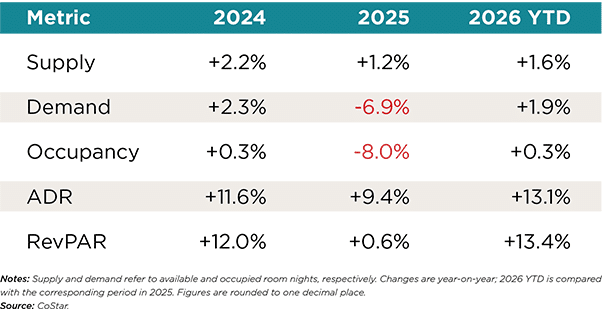
Indonesia’s hotel recovery has not followed a straight line. Hotels rebuilt rates in 2024, only for demand to fall sharply in 2025 as austerity measures by the government led to travel and meeting budgets being cut. The episode was a useful reminder that rising visitor numbers do not automatically fill hotel rooms. Demand started to grow back in 2026, but occupancy barely moved. Rates are doing most of the work—and that is both the good news and the question mark. Hotels with real pricing power should benefit; for others, higher ADR may be doing more to protect the P&L than to signal a fuller recovery.
Performance by Positioning
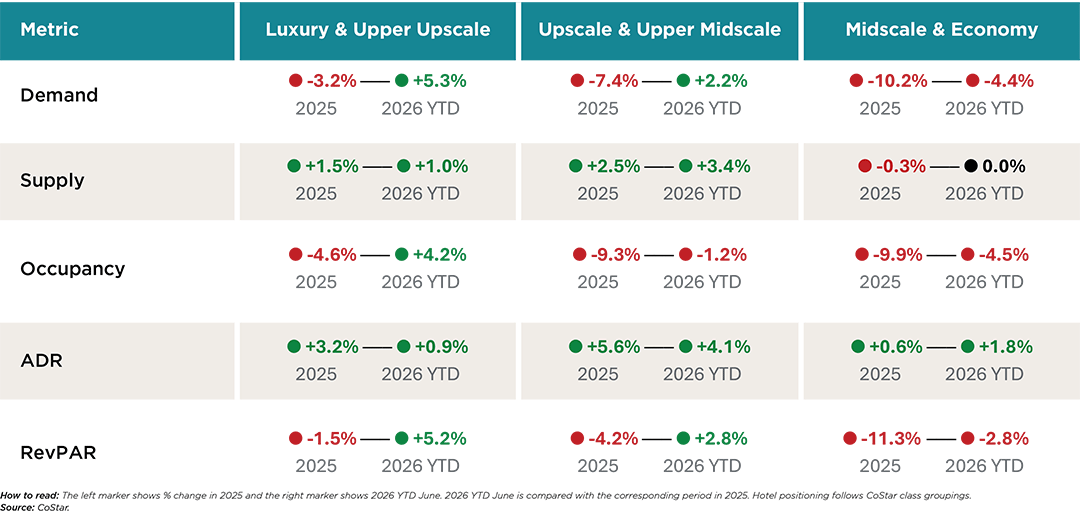
The recovery has developed a clear pecking order. Luxury and Upper Upscale hotels moved from the smallest demand decline in 2025 to the strongest growth in 2026 YTD, with limited new supply helping occupancy recover. Premium hotels are not relying on rates alone; they are filling more rooms as well. This is consistent with a wider shift towards premium travel, where stronger international demand and more di erentiated products have given better-positioned hotels greater room to recover.
The middle of the market is having to work harder. Upscale and Upper Midscale hotels have returned to demand growth, but supply is arriving faster and occupancy remains under pressure; that being said, the rate growth is keeping RevPAR positive. Midscale and Economy hotels have yet to turn the corner. With demand still falling and little help from pricing, the segment is carrying the weakest part of the recovery.
Performance by Market
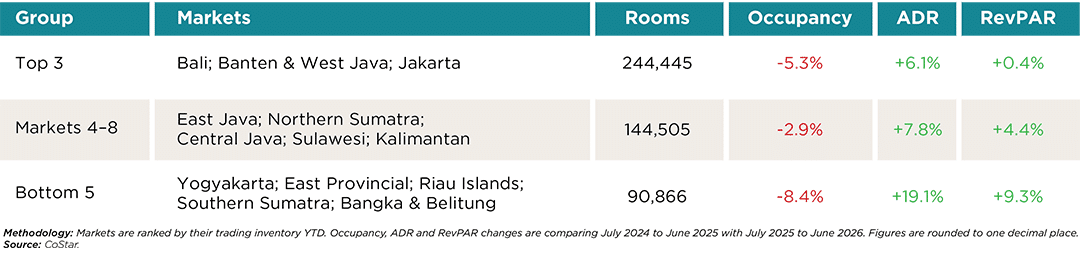
Indonesia’s biggest hotel markets are not currently its fastest-moving ones. Bali, Jakarta, and Banten & West Java hold roughly half of the tracked room inventory, but their combined rate growth has only just off set lower occupancy. Size gives these markets visibility and depth; it does not make them immune to softer demand.
The better balance sits one tier below. Markets ranked fourth to eighth also lost occupancy, but stronger pricing translated into clearer RevPAR growth. Their collective performance suggests that Indonesia’s hotel story is becoming less concentrated: regional business, domestic travel and local demand generators are creating value beyond the country’s best-known gateways.
The bottom five tell a different story. Despite the sharpest occupancy decline, rapid ADR growth produced the strongest combined RevPAR increase. That does not make them the new market leaders: smaller inventories and very different demand drivers can make averages move quickly. It does, however, show that pricing power is appearing in places that national headlines can easily miss.
Regional Comparison
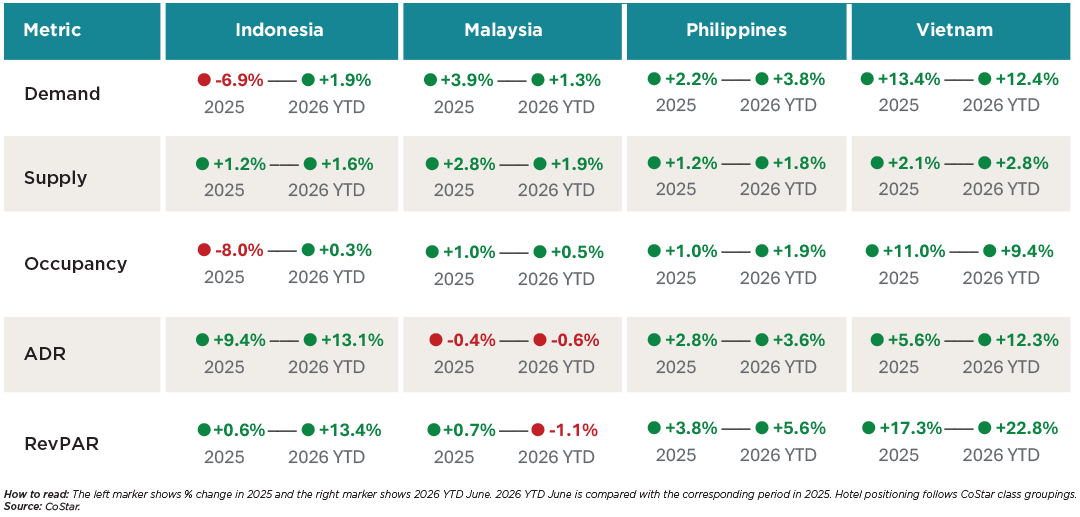
Indonesia’s numbers become more revealing when placed beside its neighbours. The four markets are benefiting from the same regional tailwinds—stronger air connectivity, returning international travel and resilient domestic demand—but the hotel outcomes are quite different. Vietnam is winning on both volume and performance, the Philippines on balanced growth, Malaysia on stability and Indonesia on price growth. The contrast is useful because each route says something different about the quality, and durability, of growth.
Vietnam is the region’s clear growth story. Easier visas, wider air access and a strong return of Asian source markets have pushed demand well ahead of new supply; the government is now targeting 25 million international visitors in 2026 after a record 2025. The Philippines is progressing more evenly, with domestic travel, M.I.C.E. and improving regional access supporting both occupancy and rates. Malaysia sees continual demand expansion; however, additional supply and limited pricing potential are expected to constrain the market’s upside. Indonesia follows a different pattern. Occupancy has barely moved, yet ADR growth is stronger. Part of this reflects genuine pricing power, particularly at the upper end; part may reflect the loss of lower-rated government and group business. Either way, hotels are charging more without filling more rooms. That is a useful position, but it is still an incomplete recovery. Vietnam must absorb what it builds; Indonesia must prove that higher prices can eventually bring fuller hotels with them.
Conclusion
Indonesia’s hotel market is not short of positive signals. Visitor volumes are growing, tourism activity is outpacing the wider economy and regional comparisons show clear pricing power. Yet the market has still been repriced faster than it has been refilled. That makes the growth useful, but not simple. Higher ADR has protected revenue, but it can mean different things in different places: genuine pricing power, a more premium demand mix, tighter room availability or a partial cover for demand that has not fully returned. This distinction is now the main investment question.
Premium hotels appear better placed because they are adding both rate and room-night recovery. The middle of the market is likely to face a tougher balance between new supply, occupancy pressure and rate discipline. Smaller destinations may continue to surprise, but their performance needs to be read with care given narrower demand bases and smaller inventories. The next phase will not be decided by whether Indonesia adds more rooms or charges higher rates. It will be decided by where demand is deep enough, product is sharp enough and pricing is strong enough to turn a rate-led recovery into a fuller one.

For more information, please contact Satria Wei at satria@hotelivate.com, Sanaya Jijina at sanaya@hotelivate.com, or Mihir Chalishazar at mihir@hotelivate.com
