
Sri Lanka: An Island of Opportunities
Sri Lanka has long been one of Asia’s most distinctive tourism destinations. Few markets offer the same combination of beaches, wildlife, mountains, culture and religious heritage within such a compact geography. This diversity has helped the country attract a broad range of travellers and made tourism an important contributor to the national economy. Yet Sri Lanka’s tourism story has often been shaped as much by disruption as by opportunity. The Easter attacks in 2019, the COVID-19 pandemic and the economic and political crisis of 2022 each interrupted the sector’s growth. Investor confidence, international connectivity and visitor demand have therefore been repeatedly tested, creating a series of start-stop cycles for the industry.
The past three years suggest that the market is entering a different phase. International visitor arrivals have surpassed their previous peak, hotel performance has strengthened, and interest from investors, brands and developers is returning. However, the improvement in performance comes with its own nuances. Source markets, spending patterns, connectivity and seasonality have all changed, reshaping the relationship between visitor growth and hotel performance. These shifts are also creating opportunities across different regions and hotel segments. Understanding them is central to assessing Sri Lanka’s evolving position within Asia’s hospitality landscape
Economy and Tourism Overview
Sri Lanka has come a long way since the crisis of 2022. The country has restored a degree of stability through debt restructuring, fiscal reforms and support from multilateral institutions. Real GDP grew by 5.0% in both 2024 and 2025, inflation fell sharply from crisis-era levels and foreign exchange reserves improved. Greater political stability has also helped rebuild confidence in the wider economy. The operating environment is therefore more stable than it was only a few years ago. That being said, growth is expected to moderate as global headwinds persist. Forecasts for 2026 from the IMF, World Bank and Asian Development Bank range from 3.0% to 4.0%. Several indicators have also softened during the year. Inflation has accelerated, the Sri Lankan rupee has weakened against the US dollar after strengthening in 2024 and remaining relatively stable in 2025, and the current account has returned to deficit. Similar pressures have emerged across several Asia-Pacific economies. Nevertheless, global volatility is likely to continue influencing economic performance over the near term.
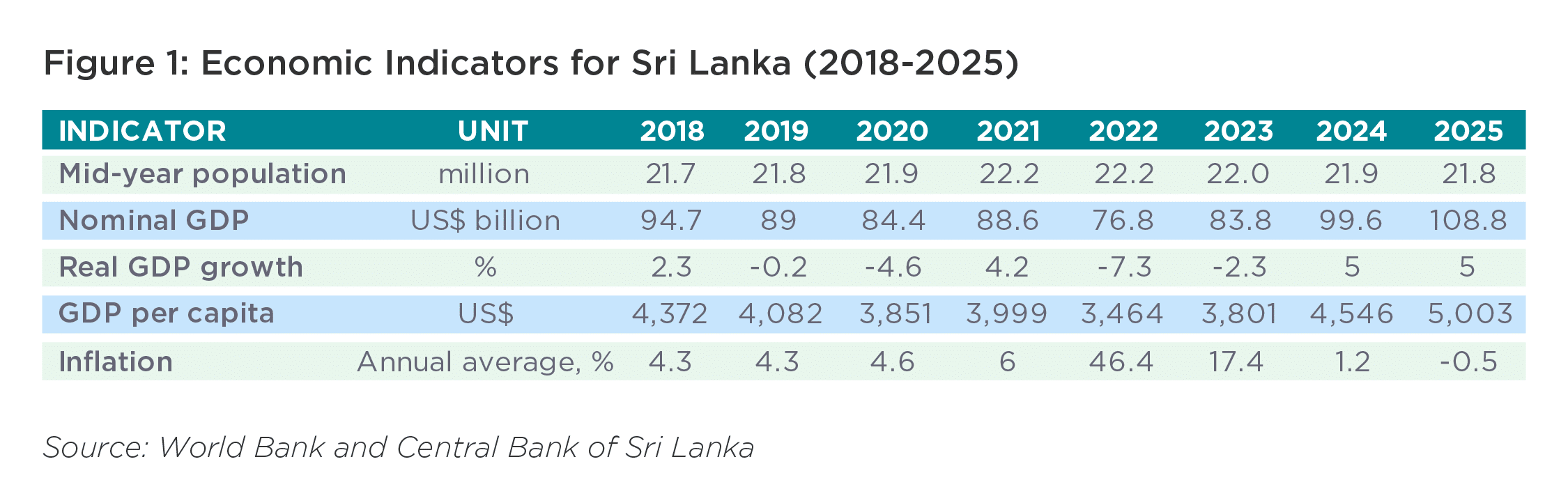
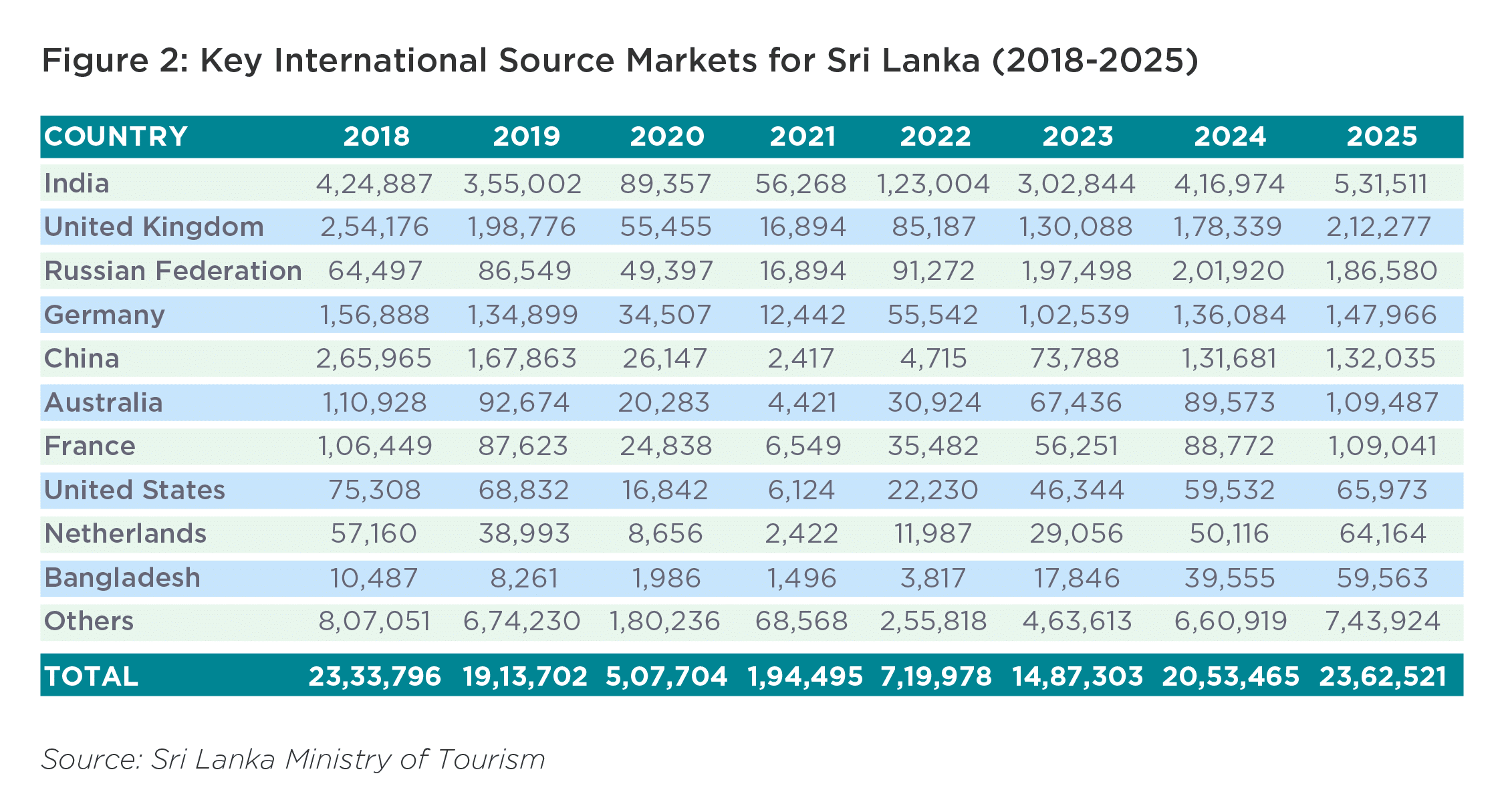
Tourism remains an important part of Sri Lanka’s economy. According to WTTC, travel and tourism accounted for approximately 10% of GDP and 11% of employment in 2025. International travel remains the main source of tourism earnings, while domestic tourism provides a base of demand across several parts of the country. Sri Lanka welcomed 2.36 million international visitors in 2025, surpassing the previous record of 2.33 million achieved in 2018. The momentum carried into early 2026, with arrivals in January and February exceeding both 2025 and 2018 levels. However, arrivals weakened through March and April as disruption across Middle Eastern aviation networks affected regional travel flows. By the end of August 2026, Sri Lanka had welcomed approximately 1.54 million visitors, slightly below the corresponding period in 2025.
The structure of demand has also changed since the pandemic. India has strengthened its position as Sri Lanka’s largest source market and now contributes just under one-quarter of international arrivals. China continues to recover, while the United Kingdom and Germany remain important long-haul markets. Russia, which became a significant source market during the post-pandemic period, softened during 2026. These shifts matter because source markets differ in their travel patterns, average length of stay and spending behaviour. This is becoming visible in the wider tourism data. International arrivals increased by more than 15% in 2025, but tourism earnings grew at a much slower pace. Earnings subsequently declined during the first seven months of 2026, despite visitor arrivals remaining broadly stable. Part of this difference reflects changes in measurement methodology, but the figures also show that visitor volumes and tourism earnings do not always move together.
Hotel Market Performance
Sri Lanka’s hotel sector has historically faced a different set of challenges from many competing destinations in Asia. Repeated external shocks have created stop-start development cycles, preventing the market from enjoying an extended period of uninterrupted growth. This has affected both the pace of hotel development and the expansion of internationally branded supply. The country’s supply profile is also unusual, with more than half of its branded inventory positioned in the upscale segment or above, creating an inverted pyramid compared with many regional markets. Outside Colombo and a few established leisure destinations, much of the hospitality inventory remains independently owned and operated. This has helped preserve the individuality of the market, with many hotels built around their setting, heritage and local character rather than a standard brand offering. However, it has also limited the reach of international distribution systems, loyalty programmes and established operating platforms across several regional markets. For a country with a large base of international travellers, Sri Lanka has therefore followed a distinct path: individuality has often taken precedence over the distribution, sales and marketing machinery, consistency and standards offered by established hotel brands.

The sector’s operating performance reflects the broader improvement in tourism demand. Demand growth has exceeded supply growth since 2024, supporting gains in occupancy and RevPAR. The strongest improvement came during the initial rebound, when international travel returned and hotels achieved a sharp increase in room rates. Since then, rate growth has moderated, but demand and occupancy have continued to strengthen. This allowed the sector to maintain double-digit RevPAR growth in 2025 and through the first seven months of 2026. Sri Lanka’s price positioning also distinguishes it from competing destinations. Despite the increase in rates over the past few years, upper upscale and luxury hotels remain comparatively affordable. In many cases, average rates are around 15% to 20% below comparable hotels in Thailand, Indonesia and Vietnam. This gives travellers access to higher-quality accommodation at a lower price point, while leaving headroom for rates to grow as the market develops. Sri Lanka is therefore not short of quality. In many cases, that quality is simply priced below its regional peers.
Key Markets and Regions in Sri Lanka
National performance provides the broader context, but Sri Lanka’s hotel sector comprises several distinct regional markets. The following overview outlines their demand base, supply character and stage of development.
Colombo and the Western Region
Colombo is Sri Lanka’s commercial and financial centre and its largest hotel market. Demand comes from corporate travel, government activity, diplomatic missions, M.I.C.E., airline business and leisure, giving the city a broader and less seasonal base than the resort markets. Gaming and casino-led travel are also gaining traction. The region has the country’s largest concentration of international brands, ranging from business and luxury hotels to mixed-use developments. Recent supply additions, including the two hotels within City of Dreams, have widened the city’s offering but also increased competition.
The next phase of development is likely to be influenced by larger infrastructure and mixed-use projects. Port City Colombo, the country’s largest public-private partnership project, is being developed as a Special Economic Zone and financial and commercial hub. Its mix of offices, residences, hospitality, entertainment, healthcare and education are likely to broaden Colombo’s demand base over time. The planned expansion of Bandaranaike International Airport should also improve gateway capacity, although Colombo must still convert more transit and gateway traffic into longer city stays.
Beyond the capital, Negombo and Katunayake benefit from airport, transit and short-stay demand, supported by Bandaranaike International Airport and the Colombo-Katunayake Expressway. Further north, Kalpitiya offers a more leisure-led proposition built around its coastal setting, islands, kitesurfing and other water-based activities. Together, these markets give the Western Region a wider demand profile than Colombo alone, spanning commercial, gaming, airport and coastal leisure travel.

Southern Coast
The Southern Coast is Sri Lanka’s most established leisure corridor, extending from Bentota and Beruwala through Galle, Weligama and Mirissa to Tangalle and Hambantota. Its mix of beaches, heritage, surfing, wellness and access to wildlife destinations supports a broad accommodation base, including conventional resorts, luxury hotels, boutique properties, villas and smaller lifestyle-led hotels. The expressway network has improved access from Colombo and Bandaranaike International Airport, strengthening the region’s position within international touring itineraries. However, the coast is not one homogeneous hotel market. Bentota and Beruwala have a longer-established resort base, while Galle combines coastal demand with heritage tourism. Weligama and Ahangama have developed around surfing and lifestyle-led travel, whereas Mirissa has a stronger short-stay and nightlife orientation. Galle’s UNESCO conservation controls, coastal regulations and limited land availability constrain large-scale development within its established areas, while the wider availability of land towards Dedduwa, Tangalle and Hambantota provides greater scope for new supply.
Cultural Triangle
Centred on Sigiriya, Dambulla, Habarana, Anuradhapura and Polonnaruwa, the Cultural Triangle forms the core of Sri Lanka’s heritage circuit. Its UNESCO World Heritage Sites, ancient cities, religious landmarks, archaeological attractions and nearby wildlife areas support international touring, domestic leisure and pilgrimage demand. The accommodation base comprises resorts, nature lodges, boutique hotels and smaller independent properties. Most visitors stay briefly before continuing to Kandy, the Hill Country or the coast, giving the region an established place within multi-destination itineraries but limiting the length of stay in individual markets. Road access remains central, and the planned expansion of the Central Expressway should improve connectivity with Colombo, Kandy and Dambulla. Public initiatives have also focused on visitor facilities at cultural sites. However, the experience remains centred largely on the attractions themselves, with further scope to improve interpretation, amenities and movement between sites.
Kandy and the Hill Country
Kandy and the central highlands combine religious tourism, tea-country experiences, scenic rail journeys, cooler weather, waterfalls and nature-based activities. Kandy is both a destination in its own right and a gateway to Nuwara Eliya, Ella, Bandarawela and the surrounding tea estates. This supports a mix of international touring, domestic leisure and pilgrimage demand. Accommodation ranges from city hotels and heritage properties to tea-estate bungalows, boutique retreats and independent guesthouses. The landscape and existing building stock provide a natural base for experiential, wellness and adaptive-reuse concepts. However, mountainous terrain, long transfers and uneven road access constrain movement, particularly for larger groups. The Central Expressway could improve access to Kandy, while cable-car systems have been proposed for Ella, Sri Pada and Kikiliyamana. These remain proposals, and the region’s environmental sensitivity and infrastructure capacity will continue to influence the pace and form of development.

Eastern Coast
The Eastern Coast comprises several markets with different demand profiles. Trincomalee and Nilaveli combine beaches, marine activities and cultural attractions; Pasikudah has a more leisure-led supply base; and Arugam Bay is centred on surfing and independent travel. The region’s principal advantage is its complementary seasonality to the Southern Coast, allowing Sri Lanka’s beach season to move east during the south-west monsoon. Accommodation remains relatively limited, with organised resorts concentrated in Pasikudah and a larger share of independent hotels and guesthouses elsewhere. This leaves room for new and differentiated products but also reflects the limited depth of year-round demand. Access remains a constraint, with Kuchchaveli located approximately five hours by road from Colombo. SLTDA has identified Kuchchaveli, Pasikudah and the wider eastern corridor for tourism development, including 445 acres at Kuchchaveli. The region’s progress will nevertheless depend on better roads, utilities and destination infrastructure, as well as its ability to extend demand beyond a relatively short peak season.
Northern Sri Lanka
Northern Sri Lanka remains the country’s least developed major tourism region. Jaffna anchors the market through its culture, cuisine, religious sites, colonial history and ties with the Sri Lankan diaspora, while Mannar and the surrounding islands broaden the region’s appeal through birdlife, coastal landscapes and heritage. Mannar also marks the Sri Lankan end of Ram Setu, or Adam’s Bridge, a chain of shoals extending towards Rameswaram in India that carries religious significance through its association with the Ramayana. This connection adds another dimension to pilgrimage and cultural itineraries centred on northern Sri Lanka and southern India. Demand is nevertheless still led by domestic travel, visiting friends and relatives, religious tourism, government and institutional business, and a smaller base of international leisure visitors. Accommodation remains predominantly independent, with limited branded and full-service supply. Road, rail and domestic air links provide access, while the passenger ferry between Nagapattinam and Kankesanthurai reconnects northern Sri Lanka with Tamil Nadu through a crossing of approximately three to four hours. The route supports tourism and pilgrimage flows without requiring travellers to enter through Colombo. However, distance from the main international gateway, limited visitor facilities and the region’s weak integration into mainstream itineraries continue to constrain demand. Its development is therefore likely to remain gradual, supported by closer links with southern India, greater destination awareness and stronger integration of Jaffna, Mannar and the wider north into Sri Lanka’s cultural circuits.

Conclusion
Few destinations in Asia can match Sri Lanka’s range of experiences within such a compact geography. This diversity gives the country several sources of tourism demand rather than leaving it dependent on a single destination or travel segment. As connectivity improves and travellers look beyond established tourism centres, Sri Lanka has the opportunity to deepen demand across both mature and emerging markets. The path may not always be straightforward, but the fundamentals remain intact. The island’s next phase will be shaped by how effectively it builds on these strengths and converts its natural tourism appeal into a broader and more mature hospitality market.
For more information, please contact Sanaya Jijina sanaya@hotelivate.com,or Mihir Chalishazar mihir@hotelivate.com
